What’s Mappen’in?

Greetings McDaniel students! My name is Meredith Meyers, a recent biology graduate. Dr. Jacobs, my fearless undergraduate research advisor, informed me of the blog and asked me to write an entry about my experience mapping the sea floor.

As a recent graduate, I was fortunate enough to receive a full-paid internship with the National Oceanic and Atmospheric Administration (NOAA) aboard the Okeanos Explorer to participate in sonar mapping of the Northeast Canyons in the Atlantic Ocean. The Okeanos is an educational research vessel whose main mission is ocean exploration (Okeanos-primary Greek water deity; Explorer-one who travels in search of scientific information). We left Norfolk, VA on May 27th and arrived back in port in Davisville, Rhode Island on June 13th.

A nervous intern, about to board the Okeanos Explorer in Norfolk, VA

As excited as I was to be selected as an intern, I was super nervous about living at sea for three weeks! How would I react to not seeing land for that long a time? Would I get seasick? What if the food isn’t good? What if I run out of shampoo? All of these questions lingered in my head as I lugged my overstuffed duffel bag up the gangplank.

You’ll be happy to know that I adapted extremely fast to living at sea. Before we left port, I stocked up on the necessary toiletries and snacks, just to be safe. Upon meeting the other members of the science team, I quickly realized I was the “baby on board”- the youngest and most inexperienced member! Being the newbie has its perks, however. Mapping took place 24 hours a day, which meant team members had to be in the control room around the clock. I was lucky to receive the 8am-4pm shift. My fellow intern, a graduate student at Old Dominion University, was not so lucky, receiving the 8pm-4am shift.

Learning the ropes of multibeam sonar mapping was smoother than I could have imagined. The science team was extremely patient in explaining how multibeam sonar works, and what my duties were during my shift. From 8am to noon, I kept log books updated and watched over the multibeam monitor to make sure the data we were collecting was usable. While mapping these canyons, the water depth changes drastically, and if the multibeam is not compensated for these changes, the data will be useless. From 12:30 to 4pm, it was my turn to clean the data we were receiving in a program called CARIS. A picture of what canyon data looks like in CARIS lies above (terrasond.com). My primary job was to search for and remove “outliers” in the data-points that were simply out of place and were clearly not a part of the data set (a school of fish for example). Being able to view the topography of the ocean floor, literally as you float above it, was an incredible experience.

One member of the science team, David Packer, planned on using the data we collected in order to identify deep sea coral habitat within the canyons. Working for NOAA’s Northeast Fisheries Science Center, he hopes to conclude that these canyons serve as prime habitat for deep sea corals, and to begin the process of naming these canyons as marine protected areas. I interviewed Packer for the Okeanos Explorer website. The full story of his mission can be found here: http://oceanexplorer.noaa.gov/okeanos/explorations/acumen12/1204_interview/welcome.html

While onboard, I had to learn the nautical lingo. Starboard side was the right side, port side was the left, the stern was the back of the boat and bow was the front, forward meant toward the front, and aft meant toward the back. Frequently we had to contact the bridge during our shifts in order for NOAA Corp officers to position the ship where we needed to map. We had to don a headset with a microphone, and call the bridge using a switch board saying “Bridge, this is survey…” (survey is lingo for control room). We also had to use phrases like “Copy that”, “Roger”, and “back deck is secured”. At first I felt silly, like I was in the military, but after the first few days these phrases became second nature.

So that was my job during my shifts! During my time off was a different story!

I shared a stateroom with another member of the science team, who recently received her PhD from the University of Delaware. We each had a bunk and a large closet, and our room was complete with our own bathroom. Additionally, our room was equipped with Direct TV, so we were never without our favorite TV shows. Our evenings consisted of Friends, Seinfeld, and Family Feud.

Meals onboard the ship were absolutely incredible! Three cooks served us hearty breakfasts, lunches, and dinners every day. Breakfast consisted of French toast, pancakes, or Belgian waffles, bacon, sausage, ham, and hash browns. If you wanted eggs, you simply took your plate to the kitchen door, informed the cook how many and how you wanted them cooked, and waited for your name to be called when they were ready. Lunches varied-pizzas, burgers and hotdogs, Reuben’s, tacos, and Swedish meatballs (one of the chef’s favorites). Dinners varied as well. Italian night consisted of ravioli and veal parmesan with homemade garlic bread, Chinese night with homemade fried rice and low mien, and our last meal was steaks and King crab legs. Homemade chocolate chip cookies were always on hand, and a freezer in the pantry was fully stocked with ice cream whenever you wanted.

Once a week, we had to participate in emergency drills. The first drill would be a fire drill, followed by an abandon ship drill. An officer would come over the intercom saying, “This is a drill, this is a drill, this an abandon ship drill”. We were required to grab a ball cap, a long sleeved shirt, long pants, our life jacket, and our survival suit (nicknamed Gumby suit because you literally look like Gumby). Once on deck, roll was called and we had to prove to the NOAA Corp officers that we could don our Gumby suits in 1 minute-easier said than done! Once the drill was complete, we could return to our regularly scheduled programming.

The weather was beautiful for most of the trip. Sunny skies and mid 60 degree temperatures made for comfortable outings on deck. Dolphin sightings in the morning and afternoon became the norm, and we were lucky enough to catch a humpback whale one morning. Occasionally, we would set up camp chairs on the fantail (back deck) and eat dinner. On Tuesday and Friday nights, we would drape a sheet over the ROV hanger on the fantail and watch a movie (The Muppets was my favorite!). One night we discovered the sea had turned neon green due to the bioluminescence of the plankton.

Sleeping onboard was never a problem either! The gentle heave and roll of the ship on the waves rocked you to sleep. In fact, the first night back in port I slept horrible because I was simply stationary. Tropical storm Beryl did cause the team one miserable night. The waves were so rough it was impossible to sleep. You were literally airborne while lying in your bunk, your personal items falling off your dresser, and your door flying open and slamming shut again in the middle of the night. Needless to say, the data collected that night were useless. But one night out of nineteen isn’t bad!

The day we pulled into port was a depressing day. I had loved living at sea. Being away from the hustle and stress of the real world was liberating, and being on the ocean is definitely where a marine biologist belongs. Shortly before we docked, our leader Meme told me I should go up on deck because land was insight. Disheartened, I declined saying I’d rather be back at sea. That night we went out to dinner and toasted our successful cruise, and sadly said our goodbyes to each other the next morning.

Now, as I search for graduate schools in the coming future, I am so thankful I was given the opportunity to participate in this expedition. It opened a whole new door and is shaping my visions for grad school and career paths. I realized I would be happy and content to be at sea frequently, and this conclusion was sealed when tears fell as I left the ship. I am know considering deep sea biology as an option for grad school, as well as earning my certificate in ocean floor mapping, in order to participate in future expeditions.

Pheww…you’re probably exhausted from reading this entry. I guess when you’re passionate about something it’s easy to get carried away. NOW McDaniel students: I challenge YOU to find your passion. Study hard, work hard, persevere! Nothing important ever comes easy. Try new things, especially the things that scare you, and take chances! That’s where I found my passion-on the open ocean.

“We lose ourselves in the things we love. We find ourselves there too.”

The science team of the EX1204 on the fantail. I'm in the "L"!!

Full picture of the Okeanos Explorer at sea! (moc.noaa.gov)

Share

Invertebrate Ball!

At Friday Harbor Labs, the biggest party of the year is the Invertebrate Ball.  Everyone dresses up as their favorite invertebrate or invertebrate-related pun, there are judges and prizes and invert-themed snacks, and the dancing goes late into the night.  McDaniel was well represented!

From left to right: Joe "Noctiluca" Odierno, Steve "Ophlitaspongia" Hein, Deanna "Assassin Snail" Campell, Molly "Internal Wave" Jacobs

An explanation of the costumes:

Joe: Noctiluca is a free-living marine dinoflagellate famous for bioluminescence – these tiny single-celled organisms release brilliant green flashes of light when they are disturbed.  During a bloom at night, boats leave green glowing wakes and swimmers are surrounded by sparkles.  The outside of Joe’s cape was a nondescript gray, allowing him to flash the luminescent interior at appropriate moments.  He won a “people’s choice” award for this costume!

Steve: Ophlitaspongia is a genus of marine sponges, often found in the local intertidal.  They are bright orange in color.  Most predators and grazers leave them alone due to their chemical defenses, but if you look closely you can often see a small specialist nudibranch predator (Rostanga sp.)

Deanna: The assassin snail Clea helena is a small tropical freshwater snail, known as a deadly predator of other snails.  You can’t see the back of her costume in this photo, but she had a shell displaying the typical black and yellow stripes.

Molly: An internal wave is an oceanographic phenomenon – we’re all used to waves that propagate on the surface, but waves can also propagate under the surface, usually along interfaces between upper and lower bodies of water (for example, along a thermocline or halocline).  Small planktonic organisms (shown in the pictures on the box and my shirt) often collect at these interfaces.  My costume showed these organisms along an interface, and I also waved internally (from inside the box).

Share

Fun with the S.E.M.

Hello, Steve here again. It has been a month or so now at Friday Harbor and I’m still having a blast. Joe’s, Deanna’s, and my projects are going great. We are all starting to get results. While designing my experiment this spring one of my goals was to incorporate the scanning electron microscope (S.E.M.) into my research. I have always wanted to learn how to use one mainly because I think the pictures are really cool.

I did figure out how to include the S.E.M. by looking to see how morphological aspects of juvenile Oregonia gracilis affect their behavior. I am also interested in characterizing the different morphological features of the very young juveniles, as it has not been done before. Finally I am looking to see if there are any differences in setal density between different periods of O. gracilis’ life.

I learned how to use the S.E.M. last week. It is amazingly easy to use. If you can use a camera you can learn how to use the S.E.M. It only took about 5 minutes to master. The theory on how it works, on the other hand, is not so easy. Well, here are some pictures I took with it.

A carapace of an O.gracilis megalopa, the final larval stage of a crab before metamorphosis into a juvenile crab. They can look quite different between species. There are a few here that look similar but the way the spines are laid out distinguishes between them.

Compound eyeballs look tight.

A carapace of a few day old juvenile O. gracilis. All the hair like projections are called hooked setae. These are how decorator crabs attach decoration to themselves. It is a mechanical attachment much like Velcro. Hooked setae are unique to the spider crab family Majoidae.

Here is a juvenile eye ball because it looks cool. It kind of has an eye brow of hooked setae. Pretty sweet.

A close up of some of the setae. These ones are on the base of the rostrum.

Cheers,
Steve


Share

Takin’ Care of Business

It’s awesome to have data already, but now it’s time to start interpretation. Deciding how to present the data and analyze it can be challenging. My data from after one week did not really show too many patterns, but after two weeks there’s a little more to go off of. This is really exciting because now we can use that information to decide if we want to keep going with this experiment or shift it in a new direction.

This morning we actually went through and did some analysis in the JMP Pro 9 statistics program. Although my original question was how origin affected survival and zooid number, there seems to be no indication of acclimation of the Botrylloides violaceus to site of origin; at least not yet. But that is completely fine. We did find evidence of an effect of genotype on survival and growth (zooid number) which is pretty exciting on its own. Now we get to investigate more into the effects of genotype which is just as cool. Genotypes will be defined as individual adult colonies for this part of the experiment and each one will get its own container to make sure we’re keeping them separate.

To get to Fisherman’s Bay, one of our field sites, we take a motor boat out since it’s on Lopez Island. Summer seems to start after the Fourth of July, and it was clear to us when we went out that Friday and the water was calm and the sun was shining.

We’ll be out collecting tomorrow, and then it’s catching larvae back in the lab for the rest of the week until we take our new juveniles out and swap them with the current colonies. So there’s a busy week ahead of me and my lab mates as we each work on our experiments. We’ll be fighting for sea table space since both Steve and Joe are working on their trials as well. Just kidding, we’ve already worked it out since I’ll only need it for a couple of days it’s not too much of a hassle, at least I hope not.

Leaning over the docks is how you find and collect these guys. You have to watch out because if you let them slip through your fingers they sink faster than you would think.

So on top of this prep and collection week, we’re also going out whale watching this Wednesday. Last time we went to a place called Lime Kiln to watch from the shore, but we didn’t see any since the pod decided to head north on us. This time we’re going out on a boat which is pretty exciting because we can go to the whales instead of waiting for them to chance by. I’ve personally never seen whales before so I’m really looking forward to this!

That’s all for now, hope your need for science has been at least momentarily satisfied.

Share

Gon’ Crabbin’

Three weeks in Friday Harbor, and the time has flown by. As you may have already known both Steve and I are working on the organism Oregonia gracilis, a decorator crab. Steve is working with the larval and beginning juvenile stages. These early stages are teeny tiny little guys. About two weeks ago he needed to start collecting some of the larvae and we both just wanted to have some fun, so we decided to start the collection process. Now I don’t know about you, but from growing up just outside of Annapolis, MD when I think about catching crabs what comes to mind is tying some chicken necks to a string, throwing them in the water and waiting for a crab to grab on. Contrary to popular belief this isn’t how you catch larvae.


There are a couple different methods you can choose from to catch these larvae, but basically all of them involve seeing these tiny specks swimming around in the water and scooping them up into a plankton tow or small mesh net. However, in order to see and scoop these crabs you first have to find them. This part can be pretty tricky when you’re dealing with something that is only about a millimeter or so long in a great big sea. Luckily Biologists have a trick up their sleeve, Nightlighting.


Nightlighting is exactly what it sounds like. Once it gets dark (about 10:30 here) you take a nice big waterproof lamp and dip in just below the surface of the water. In a matter of minutes you’ll have larvae swarming the light, give it another minute or so, you’ll have shrimp, jellyfish, small fish, and every-once-in-awhile 1 ½ ft polychaetes swim by. The larvae are attracted to the light, and a lot of the other organisms are just there for some easy dinner.

With enough luck nightlighting is a very effective method for catching larvae. We have been out about 4 times since we’ve been here, and every time we manage to see something cool and new. Also after some very cold time dipping our hands in the water we took a few nice pictures.


Gotta go check on the crabs! Until next time from the West Side.

Share

Plaid, Flannel, or Argyle? Decisions, decisions…

Hey guys, I’m Joe Odierno, here at Friday Harbor Labs with Dr. Jacobs, Deanna, and Steve. This is our 3rd week here in the San Juan Islands and each day is filled with new and different surprises. From getting to go out dredging, to starting experiments we have all been anticipating for months, to seeing all the awesome organisms this place has to offer, it’s really a sight to see.


Between the whale watching, seal sightings, and adventure hikes, we all work hard and long on our research in the labs and field. I’m here studying Oregonia gracilis, The Graceful Decorator. These crabs are apart of the Spider Crab family and will take anything they can get their claws on and use it to decorate they carapace and legs. They mostly utilize varieties of algae, bryozoans, and sponges. It has been seen that other crabs in their order will prefer to decorate with one material more than another. I’m looking at the question, do these crabs prefer one material to another, or do they just take whatever is within claw length? I want to see if these guys go to their favorite department store and pick out their favorite shirt, or if they just go for the first one they see.


So the general process of my experiment is go out to the docks, swoop 30 to 40 of these guys into my net, bring them back to the lab, strip them down (un-decorate them)-which I must say is a pretty arduous process that usually goes long into the night- using my arsenal of watchmaker’s forceps, paintbrushes, forceps, and a handy dandy dissecting microscope, give them sometime to recover, and the next day unleash a fury of red algae, sponges, and bugula on them.  After about three days of decorating I re-strip the crabs, dry the used materials, and weigh them. I actually began my first real round the beginning of this week, so I’m stuck in this excited, edge-of-my-seat, come on guys decorate decorate decorate, type of state. Which I must say isn’t a bad thing.


Well we gotta go catch a boat, so that’s all for now from the West Side.  Until next time.


Joe Odierno


Share

Late Nights in the Lab

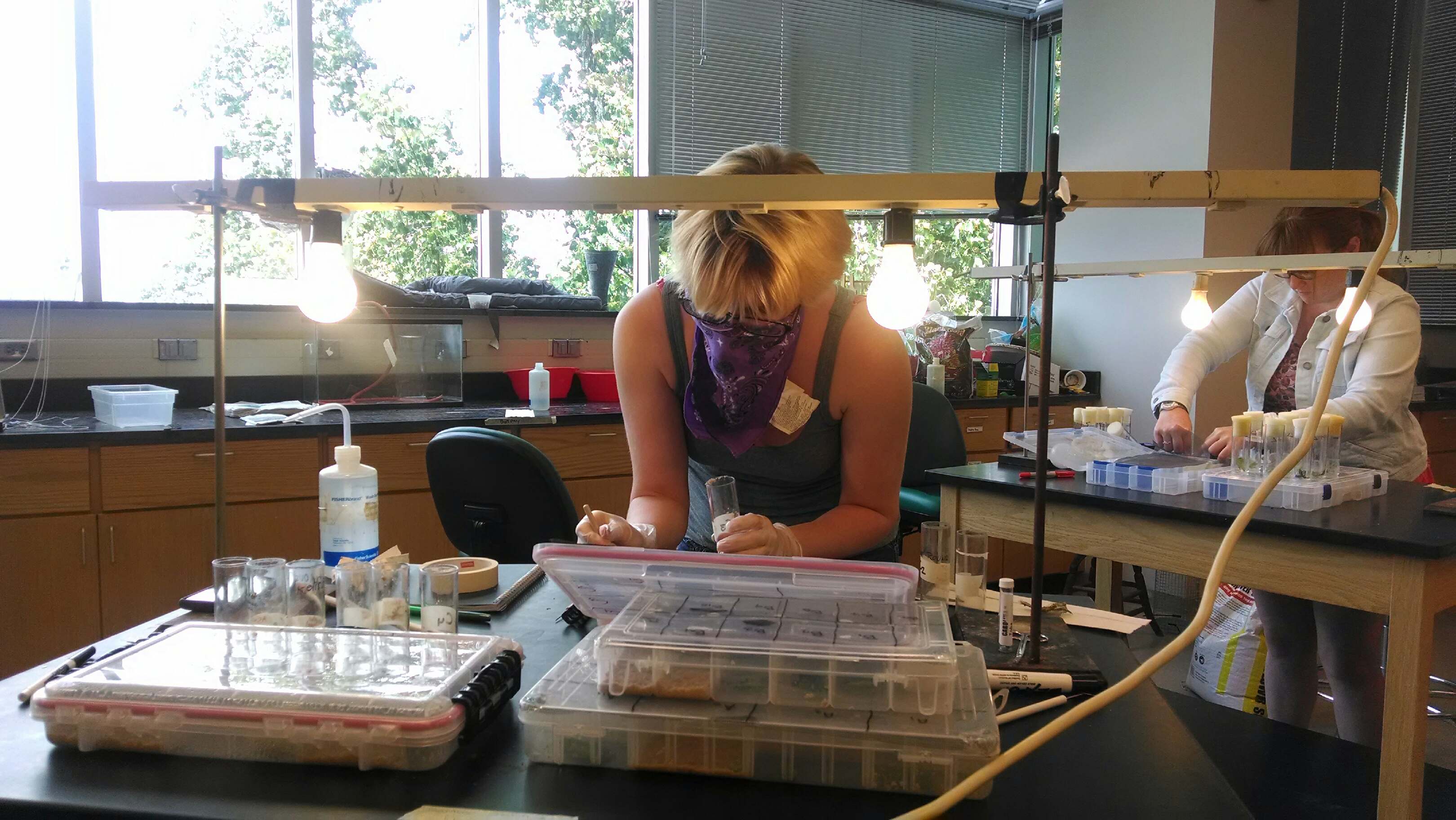
Eat breakfast, go to lab; eat lunch, go to lab, eat dinner, go back to lab. You see the pattern? Going out to the field, late hours in the lab, getting my experiment ready, getting pumped for whale watching or going out on the Centennial is all just another week in the Friday Harbor Labs (FHL). When this is the same schedule twenty others share with you it doesn’t seem as hard of a schedule. Especially when the sun doesn’t go down until ten at night, you get used to the work hard and play hard cycle that everyone seems to adopt when they come here.

My name is Deanna and I’m one of three students working with Molly this summer. My project is on Botrylloides violaceus which is an invasive here in the United States on both coasts. It originally came over from Japan and was first spotted in the 70’s here in the San Juan Islands. These sea squirts are a member of the fouling community and are pretty abundant at several harbors here in Washington. We went collecting on Tuesday last week and we found a lot at Roche Harbor (RH) and Fisherman’s Bay (FB) which are two of my field sites. We also saw a small colony of them at Cattle Point in the tide pools when we went one weekend. What I’m looking at with these guys is to see if they have any acclimation to local environmental conditions. This is important to look at because this invader is not found in some harbors (like the FHL docks) but is very abundant at others (FB). It would be interesting to find out which conditions they favor in order to see which harbors might be at greater risk of getting invaded.

This last week was really exciting as we prepped petri dishes containing juvenile Botrylloides violaceus for the field. After all the little guys were settled on the dishes we attached them to pvc trays submerged in 12°C seawater . . . while the plates were upside down. That was challenging and Molly and I worked late into the night/morning getting everything ready for deployment the next day.

With six hours or so of sleep we started up again later in the morning. We took the Coot (one of the four motor boats available for research) out to Fisherman’s Bay and hung the first of three of my contraptions. It was actually really good conditions for deployment because it was overcast. You would think that having a sunny day would make it better, but with the clouds it kept the trays cool while we assembled them in the field.

After hanging the one out at FB we headed back to the labs for lunch. In the afternoon we hung one off of the FHL docks and then took our sweet Ford Truck out to RH to hang the third and final tray. So now, my experiment has officially begun and we’ll be checking on it this Friday!

That’s all for now guys. We’ll be sure to keep you updated!

Share

A homecoming

We’ll be blogging about all the research and the cool organisms we’re working with in the coming weeks, so stay tuned for that, but first I (Molly, a.k.a. Dr. Jacobs) wanted to give you some background: Friday Harbor Labs (FHL) is a field station run by the University of Washington, and it is located in the San Juan Islands, which are a couple hour drive and a 1.5 hr ferry ride northwest of Seattle.  The Canadian border runs along Haro Strait, which separates San Juan Island (our home) from Vancouver Island.  The water is cold, the weather is cool, and the shores are rocky and steep!  Here’s a photo of the FHL dock – this is the view from right outside our lab space.

FHL is a special place for me.  I first came here as an undergraduate doing a summer research project, and this is where I really got hooked on marine science.  I came back as a graduate student, and lived and worked here for almost seven years while doing my dissertation research.  I think of this as paradise on earth, and not just because of the scenery – what really makes this place special is the scientific community.

In the summer, researchers come from all over the world to work here, and even though some of the people are very famous, the atmosphere is egalitarian: everyone from the lab director to the most junior undergraduate goes by his or her first name, and is treated as a scientific peer.  The level of science is high, and people work hard into the night, but it feels like we’re all at summer camp together.

I’m thrilled to be here with three McDaniel students!  We’ve been working hard, but on Saturday we took a break to go tidepooling in one of my favorite places on the island, Cattle Point (on the southern tip).  In this picture, rising junior Joe Odierno is standing in the low intertidal – behind him is the strait of Juan de Fuca, and behind that are the Olympic mountains!

Here’s another view of Cattle Point, this one looking a little more to the east.  The land mass in the background is another of the San Juan Islands (Lopez).  Rising senior Deanna Campbell is in the foreground; if you squint, you can see Joe and another student down on the shore:

Finally, here’s one of my favorite critters: the starfish Pycnopodia helianthoides.  These voracious predators can be more than 3 feet in diameter (!), making them the largest known starfish.  The really big ones are subtidal, though – this low intertidal specimen was much smaller.


Share

First week at Friday Harbor Labs

It has been a full week already and it flew by. Everything about Friday Harbor Labs is awesome. The ferry ride to the island is one of the most scenic things I have ever experienced. There are big rocky cliffs everywhere dropping off into the cold blue waters of the Puget Sound. In the distance you can see Mount Baker in one direction and the Olympic Mountains to the other. Both are huge snowy peaks poking up through the clouds. Giant pine trees tower above the entire lab campus. The wildlife is also spectacular. There are so many birds everywhere, a true bird watchers dream. My favorites are the quails, which are a common and very charismatic ground bird. There is actually a Rufus hummingbird buzzing around me right now. The deer here are like squirrels they are everywhere and don’t care. You walk right by them and they pay you no real attention. However, by far the most amazing thing about this place is the marine ecosystems. A quick stroll on the shore about you will see giant bull kelp, starfish, polychaetes, crabs, isopods, seals, fish, and the list goes on and on.

The people here with me are also great. It’s only been a week but we are already like a family. There are 19 or so of us I think. Basically we all work very hard from after breakfast to dinner in our labs and then we all kick back together at night. It has been a great time every night so far. I am pretty sure I have made some friends for life and future colleagues. It is so nice to be in the company of other aspiring scientists like myself. All of actual scientists here are great too. They have all been very friendly. Everyone is on a first name basis. We are all working on our own projects and at the end of the summer we will be giving a presentation about our work. Hopefully at least some of us will be able to publish; I know I would be very siked if I could.

My research is investigating the decorating behavior in the last larval stage and very young graceful decorating crabs, Oregonia gracilis. I will also be characterizing their early ontogeny as it has not been done before. One of the most exciting things to me is I have managed to incorporate the electron microscope into my work. I have always wanted to use one. Well that is all for now enjoy the pictures.


Share